1936

Plane Dippy
Release date: 1936-01-04
Plot: Porky Pig signs up to test the latest in wacky airplane technology, only to find himself battling a temperamental mechanical marvel, and the laws of physics!
Name and role: Prof. Blotz is the eccentric and grumpy inventor of the voice-controlled airplane that Porky has to test. He is a very nervous monkey who never considered what would happen if his ingenious invention met Porky's famous stutter.
Trivia and other appearances: Professor Blotz is a classic one-shot Looney Tunes character: this is his only known appearance.

Release date: 1936-01-04
Plot: Porky Pig signs up to test the latest in wacky airplane technology, only to find himself battling a temperamental mechanical marvel, and the laws of physics!
Name and role: Prof. Blotz is the eccentric and grumpy inventor of the voice-controlled airplane that Porky has to test. He is a very nervous monkey who never considered what would happen if his ingenious invention met Porky's famous stutter.
Trivia and other appearances: Professor Blotz is a classic one-shot Looney Tunes character: this is his only known appearance.

I Wanna Play House
Release date: 1936-01-11
Plot: A mischievous little bear wants to play house with his reluctant siblings, but things spiral into chaos as their pretend game gets wilder and wilder.
Name and role: The main characters are a family of nameless cartoon bears: a mother bear and her lively cubs. The youngest cub is the most playful and imaginative, constantly trying to rope his siblings into playing house, often with disastrous results. The mother bear plays the role of the long-suffering parent, attempting to keep order as the cubs' antics escalate.
Trivia and other appearances: None of these bear characters have official names, and this is their only known appearance in the Looney Tunes series.
Release date: 1936-01-11
Plot: A mischievous little bear wants to play house with his reluctant siblings, but things spiral into chaos as their pretend game gets wilder and wilder.
Name and role: The main characters are a family of nameless cartoon bears: a mother bear and her lively cubs. The youngest cub is the most playful and imaginative, constantly trying to rope his siblings into playing house, often with disastrous results. The mother bear plays the role of the long-suffering parent, attempting to keep order as the cubs' antics escalate.
Trivia and other appearances: None of these bear characters have official names, and this is their only known appearance in the Looney Tunes series.

Alpine Antics
Release date: 1936-01-18
Plot: To impress Little Kitty, Beans tries to win a wild ski race. The Cougar does his best to sabotage the race and every wacky competitor. Beans and the villain end up in a head-to-head chase all the way to the finish line.
Name and role: Tommy Turtle is the official starter of the race. Perched on a branch above the starting line, he fires the pistol to begin the competition, but the recoil knocks him out of the tree in classic slapstick fashion.
Trivia and other appearances: Tommy Turtle is a one-off character created for this short. He is sometimes mistakenly listed as a racer in online sources, but in reality, he only appears as the race's starter.
Release date: 1936-01-18
Plot: To impress Little Kitty, Beans tries to win a wild ski race. The Cougar does his best to sabotage the race and every wacky competitor. Beans and the villain end up in a head-to-head chase all the way to the finish line.
Name and role: Tommy Turtle is the official starter of the race. Perched on a branch above the starting line, he fires the pistol to begin the competition, but the recoil knocks him out of the tree in classic slapstick fashion.
Trivia and other appearances: Tommy Turtle is a one-off character created for this short. He is sometimes mistakenly listed as a racer in online sources, but in reality, he only appears as the race's starter.

Alpine Antics
Release date: 1936-01-18
Plot: To impress Little Kitty, Beans tries to win a wild ski race. The Cougar does his best to sabotage the race and every wacky competitor. Beans and the villain end up in a head-to-head chase all the way to the finish line.
Name and role: The Cougar is the burly, sneaky villain (almost identical to Disney's Pete) who does everything he can to sabotage Beans and win the race. He manages to trip up every crazy competitor but ultimately meets his match, crashing into a tree and getting trapped under the ice of the frozen lake.
Trivia and other appearances: The Cougar is a one-off antagonist created for this short. He has no official name in the cartoon's dialogue, but is identified as 'the cougar' in production notes and fan guides.
Release date: 1936-01-18
Plot: To impress Little Kitty, Beans tries to win a wild ski race. The Cougar does his best to sabotage the race and every wacky competitor. Beans and the villain end up in a head-to-head chase all the way to the finish line.
Name and role: The Cougar is the burly, sneaky villain (almost identical to Disney's Pete) who does everything he can to sabotage Beans and win the race. He manages to trip up every crazy competitor but ultimately meets his match, crashing into a tree and getting trapped under the ice of the frozen lake.
Trivia and other appearances: The Cougar is a one-off antagonist created for this short. He has no official name in the cartoon's dialogue, but is identified as 'the cougar' in production notes and fan guides.

Alpine Antics
Release date: 1936-01-18
Plot: To impress Little Kitty, Beans tries to win a wild ski race. The Cougar does his best to sabotage the race and every wacky competitor. Beans and the villain end up in a head-to-head chase all the way to the finish line.
Name and role: The duck and the dachshund are a comic duo and two of the most memorable racers in the competition. The dachshund, true to Warner Bros. tradition, is hilariously long and elastic, with the duck riding on his back throughout the race. Thanks to their physical gags, they become fan favorites and provide some of the best slapstick in the short. Notably, they are the only competitors who manage to take down the Cougar, at least until they both crash into a tree.
Trivia and other appearances: These characters don't have official names and were created just for this short.
Release date: 1936-01-18
Plot: To impress Little Kitty, Beans tries to win a wild ski race. The Cougar does his best to sabotage the race and every wacky competitor. Beans and the villain end up in a head-to-head chase all the way to the finish line.
Name and role: The duck and the dachshund are a comic duo and two of the most memorable racers in the competition. The dachshund, true to Warner Bros. tradition, is hilariously long and elastic, with the duck riding on his back throughout the race. Thanks to their physical gags, they become fan favorites and provide some of the best slapstick in the short. Notably, they are the only competitors who manage to take down the Cougar, at least until they both crash into a tree.
Trivia and other appearances: These characters don't have official names and were created just for this short.

The Phantom Ship
Release date: 1936-02-01
Plot: Beans flies to a frozen land, eager to explore a pirate ship rumored to hold hidden treasure. He doesn't realize the pirates are still aboard, waiting to thaw out and defend their loot!
Name and role: Ham & Ex are two stowaways on Beans' airplane. While Beans explores the ship, the pups end up in a frightening adventure of their own, at one point even whacking their poor uncle, mistaking him for a ghost. Ultimately, Ham & Ex are the real heroes, defeating the pirates and saving everyone.
Trivia and other appearances: Ham & Ex appear in several Looney Tunes shorts from this era, always finding trouble together. The Phantom Ship stands out for putting them at the center of the action alongside their uncle Beans.
Release date: 1936-02-01
Plot: Beans flies to a frozen land, eager to explore a pirate ship rumored to hold hidden treasure. He doesn't realize the pirates are still aboard, waiting to thaw out and defend their loot!
Name and role: Ham & Ex are two stowaways on Beans' airplane. While Beans explores the ship, the pups end up in a frightening adventure of their own, at one point even whacking their poor uncle, mistaking him for a ghost. Ultimately, Ham & Ex are the real heroes, defeating the pirates and saving everyone.
Trivia and other appearances: Ham & Ex appear in several Looney Tunes shorts from this era, always finding trouble together. The Phantom Ship stands out for putting them at the center of the action alongside their uncle Beans.

The Cat Came Back
Release date: 1936-02-08
Plot: A kitten and a mouse each ignore their mothers' warnings and sneak out to play, sparking a comic game of cat-and-mouse and a frantic chase for both families.
Name and role:The central characters are an adventurous kitten and a bold little mouse, both accompanied by their respective mothers: Mother Cat and Mother Mouse. The two mothers are so anxious for their children's safety that, in the end, they accidentally swap their babies and shower them with kisses without even realizing the mix-up.
Trivia and other appearances: None of these characters have official names, and this is their only known appearance in the Looney Tunes series.
Release date: 1936-02-08
Plot: A kitten and a mouse each ignore their mothers' warnings and sneak out to play, sparking a comic game of cat-and-mouse and a frantic chase for both families.
Name and role:The central characters are an adventurous kitten and a bold little mouse, both accompanied by their respective mothers: Mother Cat and Mother Mouse. The two mothers are so anxious for their children's safety that, in the end, they accidentally swap their babies and shower them with kisses without even realizing the mix-up.
Trivia and other appearances: None of these characters have official names, and this is their only known appearance in the Looney Tunes series.

Page Miss Glory
Release date: 1936-07-03
Plot: A small-town bellhop named Abner dreams of meeting the glamorous Miss Glory, but his fantasy takes a comic turn when he's awakened to a much less dazzling reality. This short blends daydreams, Art Deco style, and slapstick for a uniquely surreal cartoon experience.
Name and role: The 'real' Miss Glory isn't quite what Abner expected. Instead of a stunning lady, he finds a cheerful, childlike girl with blonde curls. Definitely not the dream girl he imagined.
Trivia and other appearances:She does not appear in any other Looney Tunes shorts.
Release date: 1936-07-03
Plot: A small-town bellhop named Abner dreams of meeting the glamorous Miss Glory, but his fantasy takes a comic turn when he's awakened to a much less dazzling reality. This short blends daydreams, Art Deco style, and slapstick for a uniquely surreal cartoon experience.
Name and role: The 'real' Miss Glory isn't quite what Abner expected. Instead of a stunning lady, he finds a cheerful, childlike girl with blonde curls. Definitely not the dream girl he imagined.
Trivia and other appearances:She does not appear in any other Looney Tunes shorts.

Page Miss Glory
Release date: 1936-07-03
Plot: A small-town bellhop named Abner dreams of meeting the glamorous Miss Glory, but his fantasy takes a comic turn when he's awakened to a much less dazzling reality. This short blends daydreams, Art Deco style, and slapstick for a uniquely surreal cartoon experience.
Name and role: In Abner's dream, Miss Glory appears as a dazzling, glamorous celebrity, a true Art Deco vision. She's elegant, sophisticated, and absolutely unattainable.
Trivia and other appearances:She does not appear in any other Looney Tunes shorts.
Release date: 1936-07-03
Plot: A small-town bellhop named Abner dreams of meeting the glamorous Miss Glory, but his fantasy takes a comic turn when he's awakened to a much less dazzling reality. This short blends daydreams, Art Deco style, and slapstick for a uniquely surreal cartoon experience.
Name and role: In Abner's dream, Miss Glory appears as a dazzling, glamorous celebrity, a true Art Deco vision. She's elegant, sophisticated, and absolutely unattainable.
Trivia and other appearances:She does not appear in any other Looney Tunes shorts.

Page Miss Glory
Release date: 1936-07-03
Plot: A small-town bellhop named Abner dreams of meeting the glamorous Miss Glory, but his fantasy takes a comic turn when he's awakened to a much less dazzling reality. This short blends daydreams, Art Deco style, and slapstick for a uniquely surreal cartoon experience.
Name and role: Abner is the clumsy bellhop at a rural hotel who dreams about the glamorous Miss Glory, soon coming to his hotel.
Trivia and other appearances: This is Abner's only known appearance in the Looney Tunes series.
Quote: "Gee, I sure hope I get to meet Miss Glory!"
Release date: 1936-07-03
Plot: A small-town bellhop named Abner dreams of meeting the glamorous Miss Glory, but his fantasy takes a comic turn when he's awakened to a much less dazzling reality. This short blends daydreams, Art Deco style, and slapstick for a uniquely surreal cartoon experience.
Name and role: Abner is the clumsy bellhop at a rural hotel who dreams about the glamorous Miss Glory, soon coming to his hotel.
Trivia and other appearances: This is Abner's only known appearance in the Looney Tunes series.
Quote: "Gee, I sure hope I get to meet Miss Glory!"

Boom Boom
Release date: 1936-03-14
Plot: Porky Pig and Beans the Cat are brave soldiers on a mission to rescue their captured commander, General Hardtack, from the enemy during a zany wartime adventure.
Name and role:General Hardtack is the commanding officer who gets captured by enemy forces. He spends most of the cartoon being tormented by two burly guards until he's finally rescued by Porky and Beans. The trio makes a wild escape in an airplane (which is promptly blown to pieces by enemy fire) before Hardtack eventually finds himself free, thanks to a crash landing.
Trivia and other appearances: This is General Hardtack's only known appearance in the Looney Tunes series.
Release date: 1936-03-14
Plot: Porky Pig and Beans the Cat are brave soldiers on a mission to rescue their captured commander, General Hardtack, from the enemy during a zany wartime adventure.
Name and role:General Hardtack is the commanding officer who gets captured by enemy forces. He spends most of the cartoon being tormented by two burly guards until he's finally rescued by Porky and Beans. The trio makes a wild escape in an airplane (which is promptly blown to pieces by enemy fire) before Hardtack eventually finds himself free, thanks to a crash landing.
Trivia and other appearances: This is General Hardtack's only known appearance in the Looney Tunes series.

The Blow Out
Release date: 1936-04-04
Plot: Porky Pig, a naive newsboy, gets caught up in the chaos when a wanted criminal known as the Mad Bomber terrorizes the city with explosives, until Porky's accidental heroics save the day.
Name and role: The Mad Bomber is the main villain of the cartoon: a wild-eyed, unshaven troublemaker with dark circles under his eyes and a raspy, crow-like voice. Throughout the episode, Porky Pig relentlessly tries to return a bomb to him, believing it's just a lost item. Driven to desperation, the Mad Bomber ultimately turns himself in to the police just to escape from the ever-persistent Porky.
Trivia and other appearances: The Mad Bomber appears only in this short. His look and mannerisms parody the classic 'anarchist' villains of the 1930s
Release date: 1936-04-04
Plot: Porky Pig, a naive newsboy, gets caught up in the chaos when a wanted criminal known as the Mad Bomber terrorizes the city with explosives, until Porky's accidental heroics save the day.
Name and role: The Mad Bomber is the main villain of the cartoon: a wild-eyed, unshaven troublemaker with dark circles under his eyes and a raspy, crow-like voice. Throughout the episode, Porky Pig relentlessly tries to return a bomb to him, believing it's just a lost item. Driven to desperation, the Mad Bomber ultimately turns himself in to the police just to escape from the ever-persistent Porky.
Trivia and other appearances: The Mad Bomber appears only in this short. His look and mannerisms parody the classic 'anarchist' villains of the 1930s

I'm a Big Shot Now
Release date: 1936-04-11
Plot: A cocky gangster bird and his feathered gang cause trouble in Birdville, robbing banks and stirring up chaos, until the law finally catches up with them.
Name and role: The gang of birds, led by our nameless, striped-shirted protagonist, is a group of dangerously feathered criminals. After pulling off a daring bank robbery, the story shifts to focus on their boss, whose capture takes dozens of armed officers and a shootout that lasts for nearly half the cartoon.
Trivia and other appearances: These gangster birds do not have official names and appear only in this short. Their design and mannerisms are a parody of the 1930s gangster films popular at the time, complete with fedoras, cigars, and a talent for slapstick mischief.
Release date: 1936-04-11
Plot: A cocky gangster bird and his feathered gang cause trouble in Birdville, robbing banks and stirring up chaos, until the law finally catches up with them.
Name and role: The gang of birds, led by our nameless, striped-shirted protagonist, is a group of dangerously feathered criminals. After pulling off a daring bank robbery, the story shifts to focus on their boss, whose capture takes dozens of armed officers and a shootout that lasts for nearly half the cartoon.
Trivia and other appearances: These gangster birds do not have official names and appear only in this short. Their design and mannerisms are a parody of the 1930s gangster films popular at the time, complete with fedoras, cigars, and a talent for slapstick mischief.

Westward Whoa
Release date: 1936-04-25
Plot: Westward Whoa (1936) is a Looney Tunes short directed by Jack King, featuring Beans the Cat, Porky Pig, Little Kitty, and the mischievous twins Ham and Ex. In this Western-themed cartoon, the group travels as pioneers across the frontier. Ham and Ex play pranks by pretending to spot Native Americans, causing false alarms. However, when a real attack occurs, their warnings are initially dismissed due to their previous antics. The settlers must then defend themselves against the genuine threat.
Name and role: Beans the Cat, Little Kitty, and the St. Bernard twins Ham and Ex don pioneer attire, a classic Western trope that often signified a thematic shift or a fresh setting for animated characters. This wardrobe change, featuring frontier-style clothing, was emblematic of the era's cartoons, where characters frequently donned new outfits to match the narrative's locale. This final outing serves as a send-off for the group, encapsulating their characteristic traits one last time before their retirement from the Looney Tunes lineup.
Trivia and other appearances: Notably, this short marks the final appearance of Beans, Little Kitty, and the twins Ham and Ex. The cartoon is also recognized for its portrayal of Native Americans, which includes outdated and offensive stereotypes.
Release date: 1936-04-25
Plot: Westward Whoa (1936) is a Looney Tunes short directed by Jack King, featuring Beans the Cat, Porky Pig, Little Kitty, and the mischievous twins Ham and Ex. In this Western-themed cartoon, the group travels as pioneers across the frontier. Ham and Ex play pranks by pretending to spot Native Americans, causing false alarms. However, when a real attack occurs, their warnings are initially dismissed due to their previous antics. The settlers must then defend themselves against the genuine threat.
Name and role: Beans the Cat, Little Kitty, and the St. Bernard twins Ham and Ex don pioneer attire, a classic Western trope that often signified a thematic shift or a fresh setting for animated characters. This wardrobe change, featuring frontier-style clothing, was emblematic of the era's cartoons, where characters frequently donned new outfits to match the narrative's locale. This final outing serves as a send-off for the group, encapsulating their characteristic traits one last time before their retirement from the Looney Tunes lineup.
Trivia and other appearances: Notably, this short marks the final appearance of Beans, Little Kitty, and the twins Ham and Ex. The cartoon is also recognized for its portrayal of Native Americans, which includes outdated and offensive stereotypes.

Westward Whoa
Release date: 1936-04-25
Plot: Westward Whoa (1936) is a Looney Tunes short directed by Jack King, featuring Beans the Cat, Porky Pig, Little Kitty, and the mischievous twins Ham and Ex. In this Western-themed cartoon, the group travels as pioneers across the frontier. Ham and Ex play pranks by pretending to spot Native Americans, causing false alarms. However, when a real attack occurs, their warnings are initially dismissed due to their previous antics. The settlers must then defend themselves against the genuine threat.
Name and role: Porky Pig steps into a more prominent role, signaling Warner Bros.' intent to elevate him as their leading character. Originally introduced in I Haven't Got a Hat (1935), Porky's stuttering charm quickly resonated with audiences, surpassing the popularity of his co-stars like Beans the Cat.
Trivia and other appearances: This short marks the final appearance of Beans, effectively passing the torch to Porky. His increased screen time and audience appeal in this cartoon solidified his status as Warner Bros.' first true Looney Tunes star, paving the way for his enduring presence in the franchise.
Release date: 1936-04-25
Plot: Westward Whoa (1936) is a Looney Tunes short directed by Jack King, featuring Beans the Cat, Porky Pig, Little Kitty, and the mischievous twins Ham and Ex. In this Western-themed cartoon, the group travels as pioneers across the frontier. Ham and Ex play pranks by pretending to spot Native Americans, causing false alarms. However, when a real attack occurs, their warnings are initially dismissed due to their previous antics. The settlers must then defend themselves against the genuine threat.
Name and role: Porky Pig steps into a more prominent role, signaling Warner Bros.' intent to elevate him as their leading character. Originally introduced in I Haven't Got a Hat (1935), Porky's stuttering charm quickly resonated with audiences, surpassing the popularity of his co-stars like Beans the Cat.
Trivia and other appearances: This short marks the final appearance of Beans, effectively passing the torch to Porky. His increased screen time and audience appeal in this cartoon solidified his status as Warner Bros.' first true Looney Tunes star, paving the way for his enduring presence in the franchise.

Let it Be Me!
Release date: 1936-05-02
Plot: Emily, a dreamy country hen, leaves her loyal rooster Clem for city-slicker crooner Mr. Bingo, but fame turns fowl, and after heartbreak, she's rescued by Clem, proving true love beats even the fanciest feathers.
Name and role: Emily is a sweet-hearted country hen with dreamy eyes. Originally engaged to Clem, she is swept off her feet by the charm of singer Mr. Bingo and leaves her simple rural life for the excitement of the city.
Trivia and other appearances: Emily is seen again in the short "A star is hatched" in 1938. Same story arc but with a movie director.
Release date: 1936-05-02
Plot: Emily, a dreamy country hen, leaves her loyal rooster Clem for city-slicker crooner Mr. Bingo, but fame turns fowl, and after heartbreak, she's rescued by Clem, proving true love beats even the fanciest feathers.
Name and role: Emily is a sweet-hearted country hen with dreamy eyes. Originally engaged to Clem, she is swept off her feet by the charm of singer Mr. Bingo and leaves her simple rural life for the excitement of the city.
Trivia and other appearances: Emily is seen again in the short "A star is hatched" in 1938. Same story arc but with a movie director.

Let it Be Me!
Release date: 1936-05-02
Plot: Emily, a dreamy country hen, leaves her loyal rooster Clem for city-slicker crooner Mr. Bingo, but fame turns fowl, and after heartbreak, she's rescued by Clem, proving true love beats even the fanciest feathers.
Name and role: Clem's a loyal rooster with a heart (and comb) of gold. He braves blizzards and heartbreak to win back Emily, proving that true love always crows at dawn.
Trivia and other appearances: Sadly even Clem is out of the timeline after this short. This is his last appearance.
Release date: 1936-05-02
Plot: Emily, a dreamy country hen, leaves her loyal rooster Clem for city-slicker crooner Mr. Bingo, but fame turns fowl, and after heartbreak, she's rescued by Clem, proving true love beats even the fanciest feathers.
Name and role: Clem's a loyal rooster with a heart (and comb) of gold. He braves blizzards and heartbreak to win back Emily, proving that true love always crows at dawn.
Trivia and other appearances: Sadly even Clem is out of the timeline after this short. This is his last appearance.

Let it Be Me!
Release date: 1936-05-02
Plot: Emily, a dreamy country hen, leaves her loyal rooster Clem for city-slicker crooner Mr. Bingo, but fame turns fowl, and after heartbreak, she's rescued by Clem, proving true love beats even the fanciest feathers.
Name and role: Usually known just as The French Hen, is a nightclub singer, a caricature of Irene Bordoni, who catches Mr. Bingo's wandering eye with her exotic charm. Her presence marks the breaking point between Mr. Bingo and Emily.
Trivia and other appearances: First and last appearance.
Release date: 1936-05-02
Plot: Emily, a dreamy country hen, leaves her loyal rooster Clem for city-slicker crooner Mr. Bingo, but fame turns fowl, and after heartbreak, she's rescued by Clem, proving true love beats even the fanciest feathers.
Name and role: Usually known just as The French Hen, is a nightclub singer, a caricature of Irene Bordoni, who catches Mr. Bingo's wandering eye with her exotic charm. Her presence marks the breaking point between Mr. Bingo and Emily.
Trivia and other appearances: First and last appearance.

Let it Be Me!
Release date: 1936-05-02
Plot: Emily, a dreamy country hen, leaves her loyal rooster Clem for city-slicker crooner Mr. Bingo, but fame turns fowl, and after heartbreak, she's rescued by Clem, proving true love beats even the fanciest feathers.
Name and role: Mr. Bingo is a crooning rooster, a parody of Bing Crosby, with a smooth voice and a playboy attitude. He wins Emily over with his charm and takes her to the city, but soon loses interest and leaves her for another hen.
Trivia and other appearances: Mr Bingo close his career after the fight with Clem in this very short
Release date: 1936-05-02
Plot: Emily, a dreamy country hen, leaves her loyal rooster Clem for city-slicker crooner Mr. Bingo, but fame turns fowl, and after heartbreak, she's rescued by Clem, proving true love beats even the fanciest feathers.
Name and role: Mr. Bingo is a crooning rooster, a parody of Bing Crosby, with a smooth voice and a playboy attitude. He wins Emily over with his charm and takes her to the city, but soon loses interest and leaves her for another hen.
Trivia and other appearances: Mr Bingo close his career after the fight with Clem in this very short

I'd Love to Take Orders from You
Release date: 1936-05-16
Plot: A young scarecrow takes scaring lessons from his father and tries them out before he's ready, only to face off against a tough, unflappable crow who'd rather challenge him than flee.
Name and role: Pa and Ma are the archetypal farm couple: Pa, the old pro with a broomstick backbone and a world-weary smirk, patiently showing Junior the ropes (and how to wave them menacingly), while Ma keeps the home nest cozy and cheers on her boys. Together, they're the heart and hay of the field: tough on crows, soft on family.
Trivia and other appearances: First and last for both.
Release date: 1936-05-16
Plot: A young scarecrow takes scaring lessons from his father and tries them out before he's ready, only to face off against a tough, unflappable crow who'd rather challenge him than flee.
Name and role: Pa and Ma are the archetypal farm couple: Pa, the old pro with a broomstick backbone and a world-weary smirk, patiently showing Junior the ropes (and how to wave them menacingly), while Ma keeps the home nest cozy and cheers on her boys. Together, they're the heart and hay of the field: tough on crows, soft on family.
Trivia and other appearances: First and last for both.

I'd Love to Take Orders from You
Release date: 1936-05-16
Plot: A young scarecrow takes scaring lessons from his father and tries them out before he's ready, only to face off against a tough, unflappable crow who'd rather challenge him than flee.
Name and role: Junior is a pint-sized scarecrow bursting with enthusiasm and zero experience, all floppy hat and big dreams. Enter the crow: a real feathered rascal, cocky and cunning, who'd rather outsmart Junior than be scared off.
Trivia and other appearances: The crow was scare away from Looney Tunes history after this short, same destiny for the little scarecow
Release date: 1936-05-16
Plot: A young scarecrow takes scaring lessons from his father and tries them out before he's ready, only to face off against a tough, unflappable crow who'd rather challenge him than flee.
Name and role: Junior is a pint-sized scarecrow bursting with enthusiasm and zero experience, all floppy hat and big dreams. Enter the crow: a real feathered rascal, cocky and cunning, who'd rather outsmart Junior than be scared off.
Trivia and other appearances: The crow was scare away from Looney Tunes history after this short, same destiny for the little scarecow

Fish Tales
Release date: 1936-05-23
Plot: After a wild boat ride that crashes into a battleship, Porky dozes off and dreams of being caught by a predatory fish. In his dream, he's brought to an underwater home where a fish family tries to cook him for dinner. Porky escapes, dodging various sea creatures, and finally wakes up in terror, quickly deciding to set all his caught fish free and hightail it home.
Name and role: The fish family is a twisted underwater parody of human domestic life: there's the big, blustery papa fish, the devoted mama fish, and their two mischievous little fish kids. Together, they gleefully prepare Porky as their main course, bustling around the kitchen with all the cheerful menace of a cartoon cannibal sitcom.
Trivia and other appearances: While the fish family is just here for the dream sequence and never shown again, this short is te second of Porky's earliest solo outings, establishing him as the new central character of the Looney Tunes lineup, signaling the start of his reign as the franchise's breakout star.
Release date: 1936-05-23
Plot: After a wild boat ride that crashes into a battleship, Porky dozes off and dreams of being caught by a predatory fish. In his dream, he's brought to an underwater home where a fish family tries to cook him for dinner. Porky escapes, dodging various sea creatures, and finally wakes up in terror, quickly deciding to set all his caught fish free and hightail it home.
Name and role: The fish family is a twisted underwater parody of human domestic life: there's the big, blustery papa fish, the devoted mama fish, and their two mischievous little fish kids. Together, they gleefully prepare Porky as their main course, bustling around the kitchen with all the cheerful menace of a cartoon cannibal sitcom.
Trivia and other appearances: While the fish family is just here for the dream sequence and never shown again, this short is te second of Porky's earliest solo outings, establishing him as the new central character of the Looney Tunes lineup, signaling the start of his reign as the franchise's breakout star.

Bingo Crosbyana
Release date: 1936-05-30
Plot: In a kitchen swarming with musical insects, crooner Bingo Crosbyana charms all the lady flies with his velvet voice. Until a menacing spider invades, revealing Bingo's true colors as a coward while the other bugs unite to save the day.
Name and role: Bingo Crosbyana is a smooth-talking, jazz-singing fly modeled after Bing Crosby, complete with a dapper bowtie and a laid-back attitude. He woos the ladies with his sultry crooning and self-assured swagger, but when trouble comes buzzing, Bingo's bravado fizzles and he's the first to duck for cover, showing he's all voice, no guts.
Trivia and other appearances: Bingo never appears again, but he bring with him a trivia: the cartoon's portrayal of Bingo as a vain, cowardly crooner actually led Bing Crosby himself to sue Warner Bros. for defamation. The lawsuit was ultimately unsuccessful.
Release date: 1936-05-30
Plot: In a kitchen swarming with musical insects, crooner Bingo Crosbyana charms all the lady flies with his velvet voice. Until a menacing spider invades, revealing Bingo's true colors as a coward while the other bugs unite to save the day.
Name and role: Bingo Crosbyana is a smooth-talking, jazz-singing fly modeled after Bing Crosby, complete with a dapper bowtie and a laid-back attitude. He woos the ladies with his sultry crooning and self-assured swagger, but when trouble comes buzzing, Bingo's bravado fizzles and he's the first to duck for cover, showing he's all voice, no guts.
Trivia and other appearances: Bingo never appears again, but he bring with him a trivia: the cartoon's portrayal of Bingo as a vain, cowardly crooner actually led Bing Crosby himself to sue Warner Bros. for defamation. The lawsuit was ultimately unsuccessful.

Bingo Crosbyana
Release date: 1936-05-30
Plot: In a kitchen swarming with musical insects, crooner Bingo Crosbyana charms all the lady flies with his velvet voice. Until a menacing spider invades, revealing Bingo's true colors as a coward while the other bugs unite to save the day.
Name and role: The spider is the true villain of the kitchen: a big, hairy, six-legged menace who crashes the insect party with bad intentions and a web to match. While Bingo hides, it's up to the other insects to rally together and show the real meaning of bravery.
Trivia and other appearances: The colorful spider is shown only in this short
Release date: 1936-05-30
Plot: In a kitchen swarming with musical insects, crooner Bingo Crosbyana charms all the lady flies with his velvet voice. Until a menacing spider invades, revealing Bingo's true colors as a coward while the other bugs unite to save the day.
Name and role: The spider is the true villain of the kitchen: a big, hairy, six-legged menace who crashes the insect party with bad intentions and a web to match. While Bingo hides, it's up to the other insects to rally together and show the real meaning of bravery.
Trivia and other appearances: The colorful spider is shown only in this short

Shanghaied Shipmates
Release date: 1936-06-20
Plot: Porky Pig finds himself unwillingly shanghaied aboard a pirate ship. Under the rule of a cruel pirate captain, Porky endures comic hardships, barely edible rations, and plenty of slapstick punishment. When the crew can't take it anymore, they stage a revolt, finally turning the tables on their tyrannical leaders.
Name and role: Stew is the captain's ever-loyal assistant, quick to report problems and just as quick to help 'recruit' unsuspecting patrons from the tavern into the pirate life. While he's not as menacing as the captain, Stew is happy to help enforce the captain's rules and is always in the thick of the ship's mischief.
Trivia and other appearances: First and last appearance, exactly as his beloved captain
Release date: 1936-06-20
Plot: Porky Pig finds himself unwillingly shanghaied aboard a pirate ship. Under the rule of a cruel pirate captain, Porky endures comic hardships, barely edible rations, and plenty of slapstick punishment. When the crew can't take it anymore, they stage a revolt, finally turning the tables on their tyrannical leaders.
Name and role: Stew is the captain's ever-loyal assistant, quick to report problems and just as quick to help 'recruit' unsuspecting patrons from the tavern into the pirate life. While he's not as menacing as the captain, Stew is happy to help enforce the captain's rules and is always in the thick of the ship's mischief.
Trivia and other appearances: First and last appearance, exactly as his beloved captain

Shanghaied Shipmates
Release date: 1936-06-20
Plot: Porky Pig finds himself unwillingly shanghaied aboard a pirate ship. Under the rule of a cruel pirate captain, Porky endures comic hardships, barely edible rations, and plenty of slapstick punishment. When the crew can't take it anymore, they stage a revolt, finally turning the tables on their tyrannical leaders.
Name and role: The unnamed pirate captain is a blustering, iron-fisted tyrant with zero patience and even less mercy. He keeps his crew in line through threats, bizarre punishments, and a strict 'bones-only' meal plan. Larger than life (and twice as loud), he's the ultimate cartoon bully, until his victims have had enough.
Trivia and other appearances: Typical one-shot villain
Release date: 1936-06-20
Plot: Porky Pig finds himself unwillingly shanghaied aboard a pirate ship. Under the rule of a cruel pirate captain, Porky endures comic hardships, barely edible rations, and plenty of slapstick punishment. When the crew can't take it anymore, they stage a revolt, finally turning the tables on their tyrannical leaders.
Name and role: The unnamed pirate captain is a blustering, iron-fisted tyrant with zero patience and even less mercy. He keeps his crew in line through threats, bizarre punishments, and a strict 'bones-only' meal plan. Larger than life (and twice as loud), he's the ultimate cartoon bully, until his victims have had enough.
Trivia and other appearances: Typical one-shot villain

Nutty Nurse
Release date: 1936-06-24
Plot: Slappy and Suzy are two nurses ready to stir up trouble in a hospital in Pasadena. We don't really have much more information about this meta-narrative short.
Name and role: This is yet another story of Slappy Squirrel reminiscing about her golden years in the Looney Tunes. For this short, we only have the poster. As far as their roles go, all we know is that in this hypothetical cartoon, both Suzy and Slappy were dressed as nurses, complete with pink uniforms and some truly unsettling medical props.
Trivia and other appearances: As we know, Slappy Squirrel continues her career in Animaniacs as a main character. As for Suzy, well, besides her existence in the meta-narrative, she only appears in episode 97 of Animaniacs, 'The Sunshine Squirrel.
Release date: 1936-06-24
Plot: Slappy and Suzy are two nurses ready to stir up trouble in a hospital in Pasadena. We don't really have much more information about this meta-narrative short.
Name and role: This is yet another story of Slappy Squirrel reminiscing about her golden years in the Looney Tunes. For this short, we only have the poster. As far as their roles go, all we know is that in this hypothetical cartoon, both Suzy and Slappy were dressed as nurses, complete with pink uniforms and some truly unsettling medical props.
Trivia and other appearances: As we know, Slappy Squirrel continues her career in Animaniacs as a main character. As for Suzy, well, besides her existence in the meta-narrative, she only appears in episode 97 of Animaniacs, 'The Sunshine Squirrel.

When I Yoo Hoo
Release date: 1936-06-27
Plot: In the hillbilly haven of Hickory Holler, two feuding families agree to settle their rivalry with a rooster fight, but when both birds get drunk instead of brawling, the feud erupts all over again, with the hapless sheriff caught in the crossfire.
Name and role: The Weavers and the Matthews are rowdy mountain clans made up of a motley crew of anthropomorphic animals each with their own outlandish quirks. Their chosen champions, two tough-looking roosters, are meant to settle the score in the barnyard ring, but prove to be more party animals than fighters, bringing even more chaos to their already outlandish feud.
Trivia and other appearances: First and last appearance for both families
Release date: 1936-06-27
Plot: In the hillbilly haven of Hickory Holler, two feuding families agree to settle their rivalry with a rooster fight, but when both birds get drunk instead of brawling, the feud erupts all over again, with the hapless sheriff caught in the crossfire.
Name and role: The Weavers and the Matthews are rowdy mountain clans made up of a motley crew of anthropomorphic animals each with their own outlandish quirks. Their chosen champions, two tough-looking roosters, are meant to settle the score in the barnyard ring, but prove to be more party animals than fighters, bringing even more chaos to their already outlandish feud.
Trivia and other appearances: First and last appearance for both families

Porky's Pet
Release date: 1936-07-11
Plot: Porky Pig receives a telegram from a Broadway producer offering him and his pet ostrich, Lulu, a spot in a new show for $75 a week. Eager to seize the opportunity, Porky embarks on a journey to New York City with Lulu. However, their adventure is fraught with comedic challenges, especially when they attempt to board a train that has a strict "no pets" policy.
Name and role: Lulu is Porky's exuberant and curious pet ostrich, whose antics often land them both in trouble. From swallowing passengers' belongings to causing chaos on the train, Lulu's behavior is both endearing and exasperating.
Trivia and other appearances: This short marks the debut of Lulu the ostrich, who would later appear in Porky's Moving Day. Also, this short showcases Porky's first attempt at a showbiz career, setting a precedent for future storylines.
Release date: 1936-07-11
Plot: Porky Pig receives a telegram from a Broadway producer offering him and his pet ostrich, Lulu, a spot in a new show for $75 a week. Eager to seize the opportunity, Porky embarks on a journey to New York City with Lulu. However, their adventure is fraught with comedic challenges, especially when they attempt to board a train that has a strict "no pets" policy.
Name and role: Lulu is Porky's exuberant and curious pet ostrich, whose antics often land them both in trouble. From swallowing passengers' belongings to causing chaos on the train, Lulu's behavior is both endearing and exasperating.
Trivia and other appearances: This short marks the debut of Lulu the ostrich, who would later appear in Porky's Moving Day. Also, this short showcases Porky's first attempt at a showbiz career, setting a precedent for future storylines.

I Love to Singa
Release date: 1936-07-18
Plot: Owl Jolson born into a family of classical music enthusiasts, while his siblings embrace their parents' musical preferences, OJolson is passionate about jazz. His father disapproves of jazz and, upon discovering his son's inclination, expels him from the household. Undeterred, Owl Jolson enters a radio amateur contest, where his jazz performance captivates the audience. Eventually, his family recognizes his talent and embraces his musical choice, leading to a harmonious reunion.
Name and role: The three little owlets, fresh out of their eggs, already show a spark of artistic flair: one immediately starts singing classical music, another is born with a violin in his tiny claws, and the last one emerges as a natural flute master. No names yet for these little stars of our story.
Trivia and other appearances: The Owl triplette never appears again in the storyline of WB shorts
Release date: 1936-07-18
Plot: Owl Jolson born into a family of classical music enthusiasts, while his siblings embrace their parents' musical preferences, OJolson is passionate about jazz. His father disapproves of jazz and, upon discovering his son's inclination, expels him from the household. Undeterred, Owl Jolson enters a radio amateur contest, where his jazz performance captivates the audience. Eventually, his family recognizes his talent and embraces his musical choice, leading to a harmonious reunion.
Name and role: The three little owlets, fresh out of their eggs, already show a spark of artistic flair: one immediately starts singing classical music, another is born with a violin in his tiny claws, and the last one emerges as a natural flute master. No names yet for these little stars of our story.
Trivia and other appearances: The Owl triplette never appears again in the storyline of WB shorts

I Love to Singa
Release date: 1936-07-18
Plot: Owl Jolson born into a family of classical music enthusiasts, while his siblings embrace their parents' musical preferences, OJolson is passionate about jazz. His father disapproves of jazz and, upon discovering his son's inclination, expels him from the household. Undeterred, Owl Jolson enters a radio amateur contest, where his jazz performance captivates the audience. Eventually, his family recognizes his talent and embraces his musical choice, leading to a harmonious reunion.
Name and role: Professor Fritz Owl is Owl Jolson's strict father, a classical music teacher who initially disapproves of jazz. On the other hand there's Ma Owl; a supportive figure who, despite initial shock, becomes concerned for her son's well-being after his departure.We can see both dance and sing at the end of the short, because when comes success and fame everyone agrees on it.
Trivia and other appearances: Say goodbye to this couple because after this short we will never see them again.
Release date: 1936-07-18
Plot: Owl Jolson born into a family of classical music enthusiasts, while his siblings embrace their parents' musical preferences, OJolson is passionate about jazz. His father disapproves of jazz and, upon discovering his son's inclination, expels him from the household. Undeterred, Owl Jolson enters a radio amateur contest, where his jazz performance captivates the audience. Eventually, his family recognizes his talent and embraces his musical choice, leading to a harmonious reunion.
Name and role: Professor Fritz Owl is Owl Jolson's strict father, a classical music teacher who initially disapproves of jazz. On the other hand there's Ma Owl; a supportive figure who, despite initial shock, becomes concerned for her son's well-being after his departure.We can see both dance and sing at the end of the short, because when comes success and fame everyone agrees on it.
Trivia and other appearances: Say goodbye to this couple because after this short we will never see them again.

I Love to Singa
Release date: 1936-07-18
Plot: Owl Jolson born into a family of classical music enthusiasts, while his siblings embrace their parents' musical preferences, OJolson is passionate about jazz. His father disapproves of jazz and, upon discovering his son's inclination, expels him from the household. Undeterred, Owl Jolson enters a radio amateur contest, where his jazz performance captivates the audience. Eventually, his family recognizes his talent and embraces his musical choice, leading to a harmonious reunion.
Name and role: Jack Bunny is the host of the radio amateur contest, who ultimately recognizes Owl Jolson's talent. The character's name is a playful mashup of "Jack Benny" and "jackrabbit" cementing him as a recurring in-universe radio MC and all-purpose showbiz bunny.
Trivia and other appearances: Since he is just a pun, Jack Bunny recurs in other Warner Bros. cartoons, such as The Woods Are Full of Cuckoos (1937), Slap Happy Pappy (1940), and Goofy Groceries (1941).
Release date: 1936-07-18
Plot: Owl Jolson born into a family of classical music enthusiasts, while his siblings embrace their parents' musical preferences, OJolson is passionate about jazz. His father disapproves of jazz and, upon discovering his son's inclination, expels him from the household. Undeterred, Owl Jolson enters a radio amateur contest, where his jazz performance captivates the audience. Eventually, his family recognizes his talent and embraces his musical choice, leading to a harmonious reunion.
Name and role: Jack Bunny is the host of the radio amateur contest, who ultimately recognizes Owl Jolson's talent. The character's name is a playful mashup of "Jack Benny" and "jackrabbit" cementing him as a recurring in-universe radio MC and all-purpose showbiz bunny.
Trivia and other appearances: Since he is just a pun, Jack Bunny recurs in other Warner Bros. cartoons, such as The Woods Are Full of Cuckoos (1937), Slap Happy Pappy (1940), and Goofy Groceries (1941).

I Love to Singa
Release date: 1936-07-18
Plot: Owl Jolson born into a family of classical music enthusiasts, while his siblings embrace their parents' musical preferences, OJolson is passionate about jazz. His father disapproves of jazz and, upon discovering his son's inclination, expels him from the household. Undeterred, Owl Jolson enters a radio amateur contest, where his jazz performance captivates the audience. Eventually, his family recognizes his talent and embraces his musical choice, leading to a harmonious reunion.
Name and role: The only one in his family born wearing flashy red clothes, he delights us with his hilarious swings between a grumpy pout whenever he's forced to sing classical tunes, and pure, explosive joy when he bursts into his natural, wild way of singing!
Trivia and other appearances: Since Owl Jolson is used only in this short, his song has become a true pop culture icon, famously parodied and referenced in several media. Notably, it appears in the very first episode of South Park, "Cartman Gets an Anal Probe" where characters break into the song after an alien encounter. The tune is also featured in The Looney Tunes Show (episode "Gribbler's Quest"), sung by Gossamer with updated lyrics, and even pops up in the Looney Tunes: Back in Action video game, where archival audio of Owl Jolson is used.
Personal note: I've redrawn almost every character I made back in 2020, when I first started this project. Owl Jolson was the very first one, so I decided to leave him just the way he is: clumsy, full of mistakes. To remind myself where I started.
Release date: 1936-07-18
Plot: Owl Jolson born into a family of classical music enthusiasts, while his siblings embrace their parents' musical preferences, OJolson is passionate about jazz. His father disapproves of jazz and, upon discovering his son's inclination, expels him from the household. Undeterred, Owl Jolson enters a radio amateur contest, where his jazz performance captivates the audience. Eventually, his family recognizes his talent and embraces his musical choice, leading to a harmonious reunion.
Name and role: The only one in his family born wearing flashy red clothes, he delights us with his hilarious swings between a grumpy pout whenever he's forced to sing classical tunes, and pure, explosive joy when he bursts into his natural, wild way of singing!
Trivia and other appearances: Since Owl Jolson is used only in this short, his song has become a true pop culture icon, famously parodied and referenced in several media. Notably, it appears in the very first episode of South Park, "Cartman Gets an Anal Probe" where characters break into the song after an alien encounter. The tune is also featured in The Looney Tunes Show (episode "Gribbler's Quest"), sung by Gossamer with updated lyrics, and even pops up in the Looney Tunes: Back in Action video game, where archival audio of Owl Jolson is used.
Personal note: I've redrawn almost every character I made back in 2020, when I first started this project. Owl Jolson was the very first one, so I decided to leave him just the way he is: clumsy, full of mistakes. To remind myself where I started.

Porky the Rainmaker
Release date: 1936-08-01
Plot: Porky Pig buys magical "weather pills" instead of farm feed, causing chaotic weather outbreaks when the animals accidentally eat them; until a goose finally triggers the rain that saves the drought-stricken farm.
Name and role: Phineas (someone sais his second name is "Alan") Pig is Porky's father, characterized by his gruff demeanor and shared stutter with Porky. In this version, he's portrayed as a dirt-poor farmer, a role Porky would go on to reprise many, many times in the future. Despite his bulky frame and perpetually grumpy attitude, he shows just how much he genuinely cares about his little farm and his humble livelihood.
Trivia and other appearances: Phineas Pig appeared in several Looney Tunes shorts between 1936 and 1939, including Porky the Rain-Maker (1936), Milk and Money (1936), Porky's Poppa (1938), and Porky and Teabiscuit (1939). Like Porky, Phineas is portrayed with a stutter, hinting at a family trait, and often finds himself caught in comedic misadventures alongside his son. Everytime with a slight different design.
Release date: 1936-08-01
Plot: Porky Pig buys magical "weather pills" instead of farm feed, causing chaotic weather outbreaks when the animals accidentally eat them; until a goose finally triggers the rain that saves the drought-stricken farm.
Name and role: Phineas (someone sais his second name is "Alan") Pig is Porky's father, characterized by his gruff demeanor and shared stutter with Porky. In this version, he's portrayed as a dirt-poor farmer, a role Porky would go on to reprise many, many times in the future. Despite his bulky frame and perpetually grumpy attitude, he shows just how much he genuinely cares about his little farm and his humble livelihood.
Trivia and other appearances: Phineas Pig appeared in several Looney Tunes shorts between 1936 and 1939, including Porky the Rain-Maker (1936), Milk and Money (1936), Porky's Poppa (1938), and Porky and Teabiscuit (1939). Like Porky, Phineas is portrayed with a stutter, hinting at a family trait, and often finds himself caught in comedic misadventures alongside his son. Everytime with a slight different design.

Porky the Rainmaker
Release date: 1936-08-01
Plot: Porky Pig buys magical "weather pills" instead of farm feed, causing chaotic weather outbreaks when the animals accidentally eat them; until a goose finally triggers the rain that saves the drought-stricken farm.
Name and role: At first, Dr. Quack seems like nothing more than your typical snake oil salesman, all smoke and mirrors... but oh, how wrong you'd be to underestimate him! His pills actually work, and not only do they mess with the weather, but they also twist and scramble the DNA of any animal that munches on them (the lightning-charged chicken is a dead ringer for some of the wild experiments from Gremlins II, if you catch my drift). Honestly, if this short had come out a few decades later, you can bet your last carrot that the whole "Dr. Quack" bit would've been replaced by a big, shiny ACME crate dropped from the sky.
Trivia and other appearances: This was Dr. Quack's one and only appearance, a real one-hit wonder. However, the "earthquake pills" would resurface a few years later... in the oh-so-clumsy paws of a certain hapless coyote we all know and love.
Release date: 1936-08-01
Plot: Porky Pig buys magical "weather pills" instead of farm feed, causing chaotic weather outbreaks when the animals accidentally eat them; until a goose finally triggers the rain that saves the drought-stricken farm.
Name and role: At first, Dr. Quack seems like nothing more than your typical snake oil salesman, all smoke and mirrors... but oh, how wrong you'd be to underestimate him! His pills actually work, and not only do they mess with the weather, but they also twist and scramble the DNA of any animal that munches on them (the lightning-charged chicken is a dead ringer for some of the wild experiments from Gremlins II, if you catch my drift). Honestly, if this short had come out a few decades later, you can bet your last carrot that the whole "Dr. Quack" bit would've been replaced by a big, shiny ACME crate dropped from the sky.
Trivia and other appearances: This was Dr. Quack's one and only appearance, a real one-hit wonder. However, the "earthquake pills" would resurface a few years later... in the oh-so-clumsy paws of a certain hapless coyote we all know and love.

Sunday Go to Meetin' Time
Release date: 1936-08-08
Plot: Nicodemus, a lazy and mischievous man, skips church to gamble and steal chickens. After being knocked out, he dreams he's judged by the Devil in a fiery underworld court. Terrified by his fate, he wakes up, repents, and rushes to church to set himself straight.
Name and role: Nicodemus is a caricatured African American man who avoids church to gamble and steal chickens. After a dream sequence where he's judged in the "Hades Court of Justice," he reforms and rushes to church upon awakening. Nicodemus's wife, depicted in the "mammy" stereotype, discovers Nicodemus gambling at the start of the short and admonishes him, urging him to attend church.
Trivia and other appearances: The characters featured in Sunday Go to Meetin' Time, including Nicodemus and the others, do not reappear in any future Warner Bros. cartoons. Due to the offensive racial stereotypes present, this short was later included among the "Censored Eleven" a group of cartoons withdrawn from circulation. Sunday Go to Meetin' Time is the second title from this list, and it is acknowledged here purely for historical and chronological completeness within the database.
Release date: 1936-08-08
Plot: Nicodemus, a lazy and mischievous man, skips church to gamble and steal chickens. After being knocked out, he dreams he's judged by the Devil in a fiery underworld court. Terrified by his fate, he wakes up, repents, and rushes to church to set himself straight.
Name and role: Nicodemus is a caricatured African American man who avoids church to gamble and steal chickens. After a dream sequence where he's judged in the "Hades Court of Justice," he reforms and rushes to church upon awakening. Nicodemus's wife, depicted in the "mammy" stereotype, discovers Nicodemus gambling at the start of the short and admonishes him, urging him to attend church.
Trivia and other appearances: The characters featured in Sunday Go to Meetin' Time, including Nicodemus and the others, do not reappear in any future Warner Bros. cartoons. Due to the offensive racial stereotypes present, this short was later included among the "Censored Eleven" a group of cartoons withdrawn from circulation. Sunday Go to Meetin' Time is the second title from this list, and it is acknowledged here purely for historical and chronological completeness within the database.

Porky's Poultry Farm
Release date: 1936-08-22
Plot: Porky Pig runs a poultry farm. However, a hawk constantly threatens the safety of the animals, kidnapping several birds. After yet another attack, during which a chick is captured, Porky decides to intervene personally. He takes off in pursuit of the hawk aboard an airplane.
Name and role: Henrietta is a one-shot hen, and so is her unnamed chick. They're the indirect protagonists of the story. She witnesses her chick being taken, which becomes the central focus of the whole conflict. Nothing particularly special. Although, it's worth noting that one of the hens previously kidnapped from Porky's coop is named Petunia, a nice bit of foreshadowing.
Trivia and other appearances: There are countless shorts set in chicken coops, like the entire Foghorn series for instance. But here are a few highlights: The Foghorn Leghorn from 1948, Fowl Weather from 1953, Weasel Stop from 1956, and Family Circles, where Foghorn adopts Tweety.
Release date: 1936-08-22
Plot: Porky Pig runs a poultry farm. However, a hawk constantly threatens the safety of the animals, kidnapping several birds. After yet another attack, during which a chick is captured, Porky decides to intervene personally. He takes off in pursuit of the hawk aboard an airplane.
Name and role: Henrietta is a one-shot hen, and so is her unnamed chick. They're the indirect protagonists of the story. She witnesses her chick being taken, which becomes the central focus of the whole conflict. Nothing particularly special. Although, it's worth noting that one of the hens previously kidnapped from Porky's coop is named Petunia, a nice bit of foreshadowing.
Trivia and other appearances: There are countless shorts set in chicken coops, like the entire Foghorn series for instance. But here are a few highlights: The Foghorn Leghorn from 1948, Fowl Weather from 1953, Weasel Stop from 1956, and Family Circles, where Foghorn adopts Tweety.

At Your Service, Madame
Release date: 1936-08-29
Plot: Mrs. Hamhock, a piggy widow, is targeted by conman W.C. Squeals who tries to steal her inheritance. While she plays piano, he robs her safe, but her piglet kids catch on. With a flurry of pranks and a vibrating belt, they foil the heist and kick him out.
Name and role: W.C. Fields was an American comedian and actor known for his cynical humor, nasally voice, and trademark persona as a misanthropic drunkard. His Looney Tunes counterpart is W.C. Squeals, who not only shares these charming qualities but adds a greedy, swindling streak to the mix.
Trivia and other appearances: W.C. Squeals appears in The CooCoo Nut Grove (1936) and Cracked Ice (1938), while his human caricature shows up in Hollywood Capers (1935) and Little Blabbermouse (1940).
Release date: 1936-08-29
Plot: Mrs. Hamhock, a piggy widow, is targeted by conman W.C. Squeals who tries to steal her inheritance. While she plays piano, he robs her safe, but her piglet kids catch on. With a flurry of pranks and a vibrating belt, they foil the heist and kick him out.
Name and role: W.C. Fields was an American comedian and actor known for his cynical humor, nasally voice, and trademark persona as a misanthropic drunkard. His Looney Tunes counterpart is W.C. Squeals, who not only shares these charming qualities but adds a greedy, swindling streak to the mix.
Trivia and other appearances: W.C. Squeals appears in The CooCoo Nut Grove (1936) and Cracked Ice (1938), while his human caricature shows up in Hollywood Capers (1935) and Little Blabbermouse (1940).

At Your Service, Madame
Release date: 1936-08-29
Plot: Mrs. Hamhock, a piggy widow, is targeted by conman W.C. Squeals who tries to steal her inheritance. While she plays piano, he robs her safe, but her piglet kids catch on. With a flurry of pranks and a vibrating belt, they foil the heist and kick him out.
Name and role: Piggy Hamhock (the one with the red bow) makes his first appearance in At Your Service Madame as one of the many children of a widow, while his five brothers, who change color and shirts in every scene, have neither names nor futures. The character didn't appear again after 1937, but he's remembered as one of the early prototypes of childlike comic figures in the Looney Tunes universe.
Trivia and other appearances: He returns in 1937 as the main character in Pigs Is Pigs, where he is portrayed as being obsessed with food.
Release date: 1936-08-29
Plot: Mrs. Hamhock, a piggy widow, is targeted by conman W.C. Squeals who tries to steal her inheritance. While she plays piano, he robs her safe, but her piglet kids catch on. With a flurry of pranks and a vibrating belt, they foil the heist and kick him out.
Name and role: Piggy Hamhock (the one with the red bow) makes his first appearance in At Your Service Madame as one of the many children of a widow, while his five brothers, who change color and shirts in every scene, have neither names nor futures. The character didn't appear again after 1937, but he's remembered as one of the early prototypes of childlike comic figures in the Looney Tunes universe.
Trivia and other appearances: He returns in 1937 as the main character in Pigs Is Pigs, where he is portrayed as being obsessed with food.

At Your Service, Madame
Release date: 1936-08-29
Plot: Mrs. Hamhock, a piggy widow, is targeted by conman W.C. Squeals who tries to steal her inheritance. While she plays piano, he robs her safe, but her piglet kids catch on. With a flurry of pranks and a vibrating belt, they foil the heist and kick him out.
Name and role: Mrs. Hamhok is a silly little piggy widow, the kind who seems ready to fall head over heels for the first smooth-talker who knocks on her door. She doesn't really have much of a personality, if anything, she eagerly welcomes her suitor's advances, even scolding her own piglets if they try to interfere. Honestly? Not exactly a standout character. No wonder this was both her debut and her swan song.
Trivia and other appearances: As for the theme, though, it's a classic Looney Tunes setup: widows with unruly kids or desperate rich women looking to remarry pop up again and again. We see echoes of this in His Bitter Half (1950), Hare Trimmed (1953), and Honey's Money (1962)
Release date: 1936-08-29
Plot: Mrs. Hamhock, a piggy widow, is targeted by conman W.C. Squeals who tries to steal her inheritance. While she plays piano, he robs her safe, but her piglet kids catch on. With a flurry of pranks and a vibrating belt, they foil the heist and kick him out.
Name and role: Mrs. Hamhok is a silly little piggy widow, the kind who seems ready to fall head over heels for the first smooth-talker who knocks on her door. She doesn't really have much of a personality, if anything, she eagerly welcomes her suitor's advances, even scolding her own piglets if they try to interfere. Honestly? Not exactly a standout character. No wonder this was both her debut and her swan song.
Trivia and other appearances: As for the theme, though, it's a classic Looney Tunes setup: widows with unruly kids or desperate rich women looking to remarry pop up again and again. We see echoes of this in His Bitter Half (1950), Hare Trimmed (1953), and Honey's Money (1962)

Boulevardier from the Bronx
Release date: 1936-10-10
Plot: In Hickville, a cocky big-city rooster pitcher, Dizzy Dan, shows off against the locals; jealousy flares when hen Emily swoons for the star. A barnyard baseball game follows until hometown rooster Claude cracks a game-winner that wipes the smirk off Dan's beak.
Name and role: A swaggering rooster ace for the visiting Chicago Giants; a strutting, self-promoting pitcher whose cackling taunts set the tone and whose showboating nearly steals the day... until the last swing. Clear parody of Dizzy Dean.
Trivia and other appearances: The short riffs on the popular tune "Boulevardier from the Bronx" and on Dean's celebrity aura. Often noted for a series first: the debut of "Merrily We Roll Along" as the Merrie Melodies opening theme (1936-37 blue rings/blue shield).
Release date: 1936-10-10
Plot: In Hickville, a cocky big-city rooster pitcher, Dizzy Dan, shows off against the locals; jealousy flares when hen Emily swoons for the star. A barnyard baseball game follows until hometown rooster Claude cracks a game-winner that wipes the smirk off Dan's beak.
Name and role: A swaggering rooster ace for the visiting Chicago Giants; a strutting, self-promoting pitcher whose cackling taunts set the tone and whose showboating nearly steals the day... until the last swing. Clear parody of Dizzy Dean.
Trivia and other appearances: The short riffs on the popular tune "Boulevardier from the Bronx" and on Dean's celebrity aura. Often noted for a series first: the debut of "Merrily We Roll Along" as the Merrie Melodies opening theme (1936-37 blue rings/blue shield).

Boulevardier from the Bronx
Release date: 1936-10-10
Plot: In Hickville, a cocky big-city rooster pitcher, Dizzy Dan, shows off against the locals; jealousy flares when hen Emily swoons for the star. A barnyard baseball game follows until hometown rooster Claude cracks a game-winner that wipes the smirk off Dan's beak.
Name and role: long, low, and gloriously rubbery. He steps to the plate and weaponizes an accordion-body: after contact he "stretches" between bases, turning routine plays into chaos and flustering the pitcher.
Trivia and other appearances: This stretch-dachshund base-runner functions as a reusable WB gag module. The same elastic-runner sequence turns up again in Porky's Baseball Broadcast (1940), underscoring how the "dachshund stretch" became a go-to visual punchline in the studio's cartoons.
Release date: 1936-10-10
Plot: In Hickville, a cocky big-city rooster pitcher, Dizzy Dan, shows off against the locals; jealousy flares when hen Emily swoons for the star. A barnyard baseball game follows until hometown rooster Claude cracks a game-winner that wipes the smirk off Dan's beak.
Name and role: long, low, and gloriously rubbery. He steps to the plate and weaponizes an accordion-body: after contact he "stretches" between bases, turning routine plays into chaos and flustering the pitcher.
Trivia and other appearances: This stretch-dachshund base-runner functions as a reusable WB gag module. The same elastic-runner sequence turns up again in Porky's Baseball Broadcast (1940), underscoring how the "dachshund stretch" became a go-to visual punchline in the studio's cartoons.

Boulevardier from the Bronx
Release date: 1936-10-10
Plot: In Hickville, a cocky big-city rooster pitcher, Dizzy Dan, shows off against the locals; jealousy flares when hen Emily swoons for the star. A barnyard baseball game follows until hometown rooster Claude cracks a game-winner that wipes the smirk off Dan's beak.
Name and role: Hickville's rooster pitcher and Emily's boyfriend; he starts as the insecure under-bird, fumbles, then digs in at the plate and launches the climactic grand slam that topples Dan's big-city swagger.
Trivia and other appearances: Claude's arc is a straight small-town-beats-city-slicker folk tale, common in '30s cartoons. Claude himself does not return as a named character but is clearly a recall to Clem from "Let ot be me".
Release date: 1936-10-10
Plot: In Hickville, a cocky big-city rooster pitcher, Dizzy Dan, shows off against the locals; jealousy flares when hen Emily swoons for the star. A barnyard baseball game follows until hometown rooster Claude cracks a game-winner that wipes the smirk off Dan's beak.
Name and role: Hickville's rooster pitcher and Emily's boyfriend; he starts as the insecure under-bird, fumbles, then digs in at the plate and launches the climactic grand slam that topples Dan's big-city swagger.
Trivia and other appearances: Claude's arc is a straight small-town-beats-city-slicker folk tale, common in '30s cartoons. Claude himself does not return as a named character but is clearly a recall to Clem from "Let ot be me".

Boulevardier from the Bronx
Release date: 1936-10-10
Plot: In Hickville, a cocky big-city rooster pitcher, Dizzy Dan, shows off against the locals; jealousy flares when hen Emily swoons for the star. A barnyard baseball game follows until hometown rooster Claude cracks a game-winner that wipes the smirk off Dan's beak.
Name and role: A hefty pig patterned on Babe Ruth, who steps in against Dan for a quick lesson in hubris: two blazing strikes and a swaggering laugh from the mound. Cameo-level but unmistakable as a sports-caricature hit.
Trivia and other appearances: The short's baseball gag coverage, including this caricature, feeds later compilations and remixes; and this very same character reappears in "Porky's Baseball Broadcast" (1940) with a slight recolor
Release date: 1936-10-10
Plot: In Hickville, a cocky big-city rooster pitcher, Dizzy Dan, shows off against the locals; jealousy flares when hen Emily swoons for the star. A barnyard baseball game follows until hometown rooster Claude cracks a game-winner that wipes the smirk off Dan's beak.
Name and role: A hefty pig patterned on Babe Ruth, who steps in against Dan for a quick lesson in hubris: two blazing strikes and a swaggering laugh from the mound. Cameo-level but unmistakable as a sports-caricature hit.
Trivia and other appearances: The short's baseball gag coverage, including this caricature, feeds later compilations and remixes; and this very same character reappears in "Porky's Baseball Broadcast" (1940) with a slight recolor

Boulevardier from the Bronx
Release date: 1936-10-10
Plot: In Hickville, a cocky big-city rooster pitcher, Dizzy Dan, shows off against the locals; jealousy flares when hen Emily swoons for the star. A barnyard baseball game follows until hometown rooster Claude cracks a game-winner that wipes the smirk off Dan's beak.
Name and role: bonneted hen who swoons for Dan and needles Claude into proving himself; she's the emotional hinge of the triangle, pushing the rivalry from puffed-chest boasting to genuine stakes.
Trivia and other appearances: Emmily is a living trope as MM "aspiring starlet" hen ("Let It Be Me"; "A Star Is Hatched"), and later viewers see a family resemblance to Miss Prissy, this is design echo, non-canonical kinship.
Release date: 1936-10-10
Plot: In Hickville, a cocky big-city rooster pitcher, Dizzy Dan, shows off against the locals; jealousy flares when hen Emily swoons for the star. A barnyard baseball game follows until hometown rooster Claude cracks a game-winner that wipes the smirk off Dan's beak.
Name and role: bonneted hen who swoons for Dan and needles Claude into proving himself; she's the emotional hinge of the triangle, pushing the rivalry from puffed-chest boasting to genuine stakes.
Trivia and other appearances: Emmily is a living trope as MM "aspiring starlet" hen ("Let It Be Me"; "A Star Is Hatched"), and later viewers see a family resemblance to Miss Prissy, this is design echo, non-canonical kinship.

Don't Look Now
Cupid is making people fall in love, while Satan is doing everything possible to undermine the relationships
Little Beau Porky
The cartoon opens on a fortress in the middle of a desert, home to the French Foreign Legion. The Commandant enters and looks over his group of shoddy, under-developed service men, including Porky, who does not seem to be taking his service very literally. A service man rides into the fortress on a camel to deliver to the Commandant a "Camelgram". The cable, from General Sanflee, says that Ali Mode's Riff Raffs have attacked, and to "...come at once -- Time's a wastin!"
Milk and Money
Porky's father is going to lose his farm. Porky's goes to town riding his horse. He is working a milk route, and is warned if he breaks a single bottle he will be fired. As he is delivering the milk, cats follow him, draining the bottles. Hank Horsefly follows them into town. He stings Dobbin a horse, who falls and breaks several bottles. They find themselves near a horse race, and enter it by mistake; the horse that is in the race is merely podding along until it gets stung again. Porky ends up winning the $10000 from the race, and drives home in a limo
Porky in the North Woods
Porky is running a game refuge. Despite the sign saying the opposite, Jean-Baptiste a trapper sets numerous traps. Porky is able to rescue the animals from the trap, however Jean-Baptiste is able to track him down, and he beats him up. The animals come to Porky's rescue
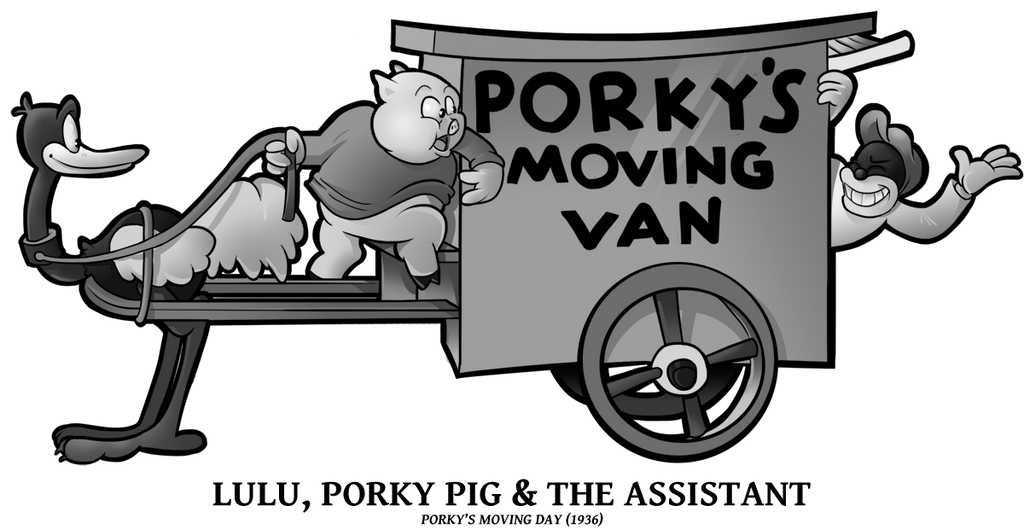
Porky's Moving Day
A woman's house, on the side of the cliff, is about to fall into the sea, thanks to waves washing away the cliff. In a panic, she call's Porky's moving company. Porky's assistant, a former boxer, starts swinging when he hears a bell until he is hit on the head, when he stops and says, "Okay, boss." Porky's van is pulled by an ostrich. They get to the house and have various adventures while moving the furniture, mostly because the entire house keeps tilting back and forth on the shaky ground. Finally, a big wave washes most of the house's contents in the van
The CooCoo Nut Grove
A night at Hollywood's fab-u-lous CooCoo Nut Grove restaurant. You never know who you will see, or be seen by. Master of ceremonies Ben Birdie (bandleader Ben Bernie) is accosted in the opening scene by Walter Windpipe (Walter Winchell). The short then proceeds to showcase a large number of Hollywood stars in the form of caricatures, including Katharine Hepburn (as a horse named Miss Heartburn), Jean Harlow, Bette Davis, Joe E. Brown, Hugh Herbert, W.C. Fields, Clark Gable, Groucho and Harpo Marx, Johnny Weissmuller, Mae West, Lionel and John Barrymore, Laurel and Hardy, Edward G. Robinson, Fred Astaire, and George Raft. Musical entertainments are provided by Dame Edna May Oliver as "The Lady in Red", the Dionne quintuplets (who were in reality only two years old at the time) and Helen Morgan, sitting on the piano, turning on the tears with a torch song
The CooCoo Nut Grove
A night at Hollywood's fab-u-lous CooCoo Nut Grove restaurant. You never know who you will see, or be seen by. Master of ceremonies Ben Birdie (bandleader Ben Bernie) is accosted in the opening scene by Walter Windpipe (Walter Winchell). The short then proceeds to showcase a large number of Hollywood stars in the form of caricatures, including Katharine Hepburn (as a horse named Miss Heartburn), Jean Harlow, Bette Davis, Joe E. Brown, Hugh Herbert, W.C. Fields, Clark Gable, Groucho and Harpo Marx, Johnny Weissmuller, Mae West, Lionel and John Barrymore, Laurel and Hardy, Edward G. Robinson, Fred Astaire, and George Raft. Musical entertainments are provided by Dame Edna May Oliver as "The Lady in Red", the Dionne quintuplets (who were in reality only two years old at the time) and Helen Morgan, sitting on the piano, turning on the tears with a torch song.
The Village Smithy
Based off the poem of the same name, the short film follows the blacksmith. As his assistant Porky gives him a rubber horseshoe, then a hot horseshoe on the back of the horse by accident
Toy Town Hall
A young tot is put to bed in the middle of listening to the Ben Bernie Orchestra on the radio. He falls asleep and dreams that his toys in the room become movie and radio stars who put on a variety show, with a bunch of musical acts. Then the youngster wakes up